Foreseeable Equity Wobbles and Powell’s Incentives

Equity Valuation Concerns

Analysts are comfortable using that twos tens got as steep as 137 basis points in December 2016 as a guide for the first target of steepening in the event that the selloff continues in Treasuries. So that puts 10-year yields at a 148 to 151 range. It goes without saying that the market loves a round numbers so 150 as a target will certainly have a fair amount of sponsorship, but before getting there, I suspect that the response of risk assets will continue to be influential in estimating just how far. this bearish price action can run. One of the key risks at this point in the cycle is that a backup in rates eventually translates through to wobbles in the equity market. We have yet to see that, but that doesn’t mean that such price action won’t ultimately occur. One of the current concerns is that we will find ourselves in a situation where 10-year yields are ranging between 130 and 145, long enough that there’s eventually a reckoning in the equity market because the move is viewed as sustainable more than just a one-off. At the moment, I would argue that what is keeping equity valuations high is the assumption that this is just a temporary spike in rates. And if it gets bad enough, the Fed will get involved.

Powell’s incentives

The eurodollar curve at this moment suggests that the market is thinking that 2023 is the year that tightening commences. For us to envision a 10 year yield above 150 or a five-year yield closer to 75 basis points, we would need to accelerate rate hike expectations. And I struggle to see an environment in which the Fed wouldn’t push back against that, because recall the Fed is actively in the process of trying to redefine investors’ understanding of the way that they’ll respond to inflation going forward. So not only will we need to see a period where inflation runs hot, but we’ll also need to see that same period accompanied by a reluctant Fed. This is the Fed’s big credibility gamble, and as we contemplate just how steep the curve can get and how far rates can back up, it’s important to keep Powell’s incentives in mind.

Now we could envision a discussion taking place about the tapering of QE, but that discussion in the public forum is very unlikely to become a reality until the very end of 2021, if not the beginning of 2022. Both the Fed and market participants remember very well the 2013 taper tantrum episode, and monetary policy officials will strive to avoid repeating that mistake. Our take is that the prospects for a true taper tantrum comparable to what we saw in 2013 are very low. First of all, the Fed certainly learned its lesson, but more importantly, the continued strides towards transparency are tangible. And so by the time the Fed makes it clear that they intend to taper, the groundwork for the decision-making will be well-established. And for that reason, I suspect that the actual tapering in this cycle will not have a dramatic impact in the Treasury Market. Said differently, by the time the Fed is willing to start the discussion on tapering, the economic data will be strong, inflation will be coming back, and the Treasury Market will have already priced in off of those macro influences the progression to the next part of the monetary policy cycle. So in essence, the Fed will allow the market to tighten financial conditions for it, and then eventually follow through with the change in monetary policy.

inflation

Retail Sales

In the week just past, the biggest economic data was a very impressive above 5% monthly gain in January for retail sales. However, it is important to keep in mind that that number was strongly influenced by stimulus checks and therefore is unlikely to be repeated in February and March, which well explains the fact that the data went almost completely ignored by the Treasury Market, supports this idea of a reluctance to push the bearishness much further even with some fundamental information in hand that would otherwise warrant higher rates.

Labor Maket

This week’s jobless claims reach a four week high. There was effectively no knee-jerk market reaction, but the fact that further declines in jobless claims are increasingly difficult to envision. This stabilization and initial jobless claims North of 700,000 is not a good indication for the pace of hiring and ultimately the wage pressures that one would like to see at this point in the recovery. And the recent rise in jobless claims also reminds us of one of the core concerns which is the depressed participation rate. The number of sideline workers continues to be problematic, and it also will presumably put downward pressure on wages once we’re further into recovery and more displaced workers are brought back in.
Double Top?

REVIEW ON THE PAST WEEK

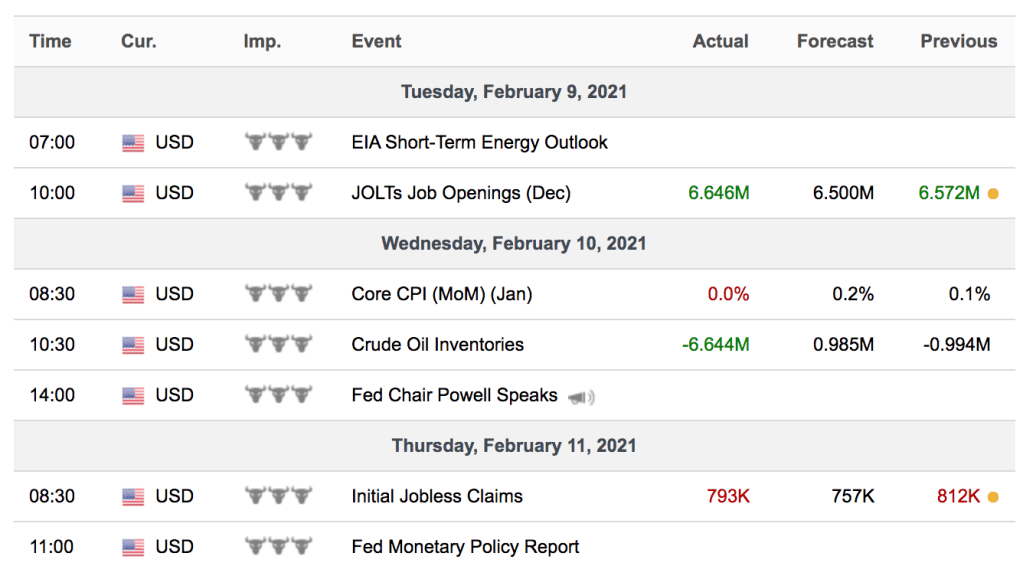
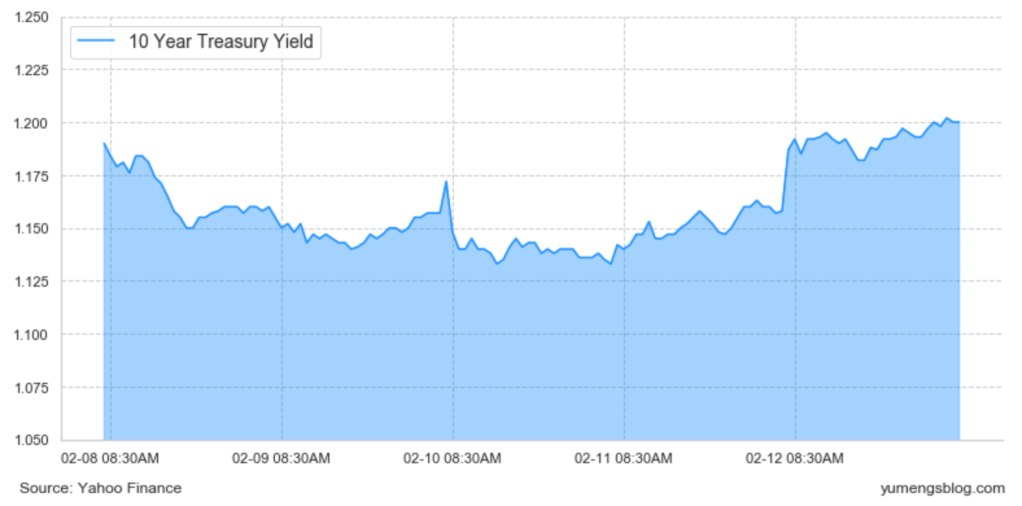
In the week just past, the Treasury market had a few key data points from which to refine forward expectations. The most relevant one on the economic data front was the disappointing core CPI print for the month of January. In January, core consumer prices were effectively flat. In addition, the Treasury market had to contend with the refunding auctions that was $58 billion in threes, which stopped through two tenths of basis point, $41 billion in new tens, which stopped through three tenths of a basis point and $27 billion in thirties, which tailed one basis point.

Post-refunding Treasury yield

One might be tempted to interpret the results of the long bond auction as a sign of a lack of sponsorship for Treasuries further out the curve. However, refunding 30s, not re-openings have a very strong tendency to tail, having done so now at 9 of the last 11 refunding auctions. This leaves us reluctant to interpret those results as anything more than strong, ongoing sponsorship for duration in the Treasury market. If nothing else, we learn that there’s a potential for reasonable domestic sponsorship for 10-year yields above 1.15. Now whether or not that translates through to the establishment of a new upper bound for 10-year rates at 1.20 remains to be seen. We’ve been focused on what from a technical perspective appears to be a double top. And that’s a double top between 1.19 and 1.20, not textbook, but close enough that it suggests the current period of consolidation might ultimately resolve in lower rates.

Reflation

The Treasury market is trading off of inflation at this point in the cycle than for trading off of the manufacturing sector data, or to a large extent ignoring the employment report. While the distinction between realized inflation and inflation expectations and the divergence that we have seen thus far in 2021 is an important backdrop as we think about the market going forward. We could very easily see the real inflation data continue to struggle as the year plays out, but inflation expectations remain high. It’s also important to keep in mind that headline CPI is heavily weighted toward the energy sector and gasoline prices. And the moves in the energy complex really adds some staying power to this rally we’ve seen in breakevens. Both five and 10-year breakevens are above 220 basis points. And while the underwhelming CPI read should on the margin detract somewhat from those expectations, the fact that we’re seeing such a meaningful pickup in crude and gasoline prices really limits any potential downside should we see a reversal.

Another key distinction is between goods inflation and service inflation. Given that the consumption patterns created during the pandemic have favored goods consumption over service consumption, it makes sense that there was upward pressure on goods prices where flagging service sector inflation became the norm. Fast forward to the second half of 2021, once the economy is reopened and re-engaged in in-person commerce, the baseline assumption for market participants at this point is that we ultimately will see more upward pressure on service sector consumption and inflation to follow.

Fiscal Stimulus

One of the background macro-factors in the market at the moment is the ongoing progress towards stimulus. It’s worth highlighting the results to our pre-NFP survey, which revealed a consensus around market expectations for the ultimate size of the fiscal deal. The most common response was between $1 and $1.25 trillion. But just as interesting, was the fact that no one thought no deal was going to come and no one thought a deal below $500 billion was going to come. For the question how much will the 10-year yield respond to a stimulus deal when it’s finally announced, using that one to $1.25 trillion consensus, anything either materially above or below that will trigger a price response in the Treasury market.

Bulk of Upside in a Classic Supply Accommodation Trade

Review on the past week

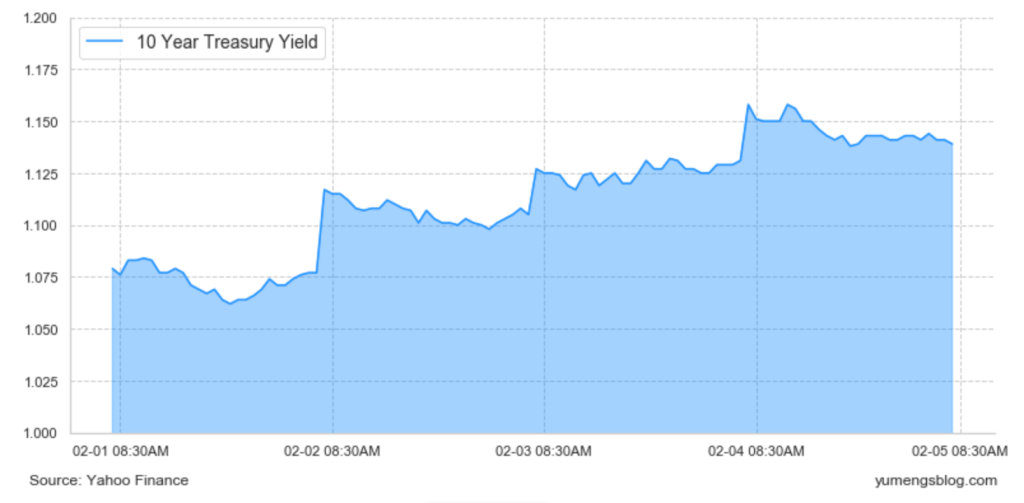
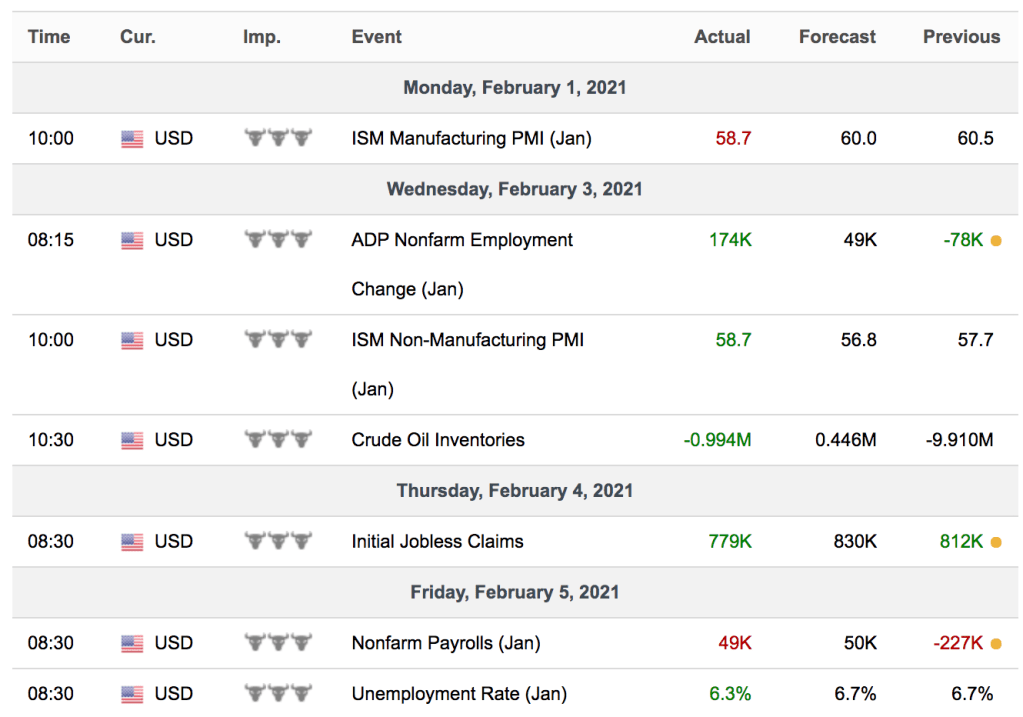
In the week just past the Treasury market had a few key inputs from a fundamental perspective to respond to in terms of pricing. On the jobs front it was a disappointing NFP print particularly within the details where we saw December revised, sharply lower, which if anything marks a relatively low departure point for the beginning of 2021 in terms of jobs growth and more importantly, the idea that the return of lockdowns is in fact having an impact on the frontline service sector and jobs creation. What was notable within the price action was we saw an intuitive bid for Treasuries on the disappointing nonfarm payrolls print, but it wasn’t able to reverse the bulk of the upside that we have seen in rates over the course of the week.

The short-lived bounce could be a reflection of next week’s refunding program with $58 billion threes, $41 billion tens and $27 billion thirties, and the disappointed job print also makes a better case for lawmakers in Washington who are attempting to push through yet another round of fiscal stimulus.

Fiscal Stimulus

This week’s survey was the fact that nobody is expecting either zero deal or a deal below $500 billion. So that does raise the bar for Congress to ultimately deliver and it speaks to this idea that there’s a reasonable amount of fiscal stimulus priced in the market at current levels.

Refunding Auctions

There will be a saturation point for Treasury issuance does remain relevant although there are key offsets that will presumably be put to test over the course of the next several auction cycles. The liquidity provided by the refunding auctions in particular is simply too enticing for big players in the Treasury market to completely ignore, so it’s safe to say that the auction process will be smooth and certainly in a traditional sense.

And on the supply front it’s worth just briefly mentioning the fact that the refunding announcement revealed coupon auction sizes are going to remain unchanged for the next quarter. Now, there was a little bit of a split consensus on whether the Treasury Department would ultimately decide to focus borrowing further out the curve, but for the time being they seemed content with the issuance profile as it is. Eventually the Treasury Department’s longer-term goal is to term debt further out and take advantage of these historically low rates. The art form behind that is to do it in such a way that doesn’t disrupt the market and subsequently lead to higher borrowing rates further out the curve.

EXPECTED V.S. REALIZED INFLATION

We can see sustainably higher inflation expectations as evidenced by breakevens, even if we don’t have that actually translate through to upside risk for inflation in the very near term. If we look at the consensus expectations for Wednesday’s CPI, they’re very much in line with what we tend to see for that series and do not suggest that we’ll be facing a period of upside pressure on consumer prices that the Fed doesn’t want to see.

Another facet that’s worth discussing is before we’re able to really see the true demand-driven type of inflation that the Fed is after, what ultimately will need to happen is upward pressure on wages and upward pressure on real wages that comes along with higher consumer confidence and thus a willingness to spend.

Thoughts on the New Normal

  • Work remotely
  • Move from high-population density areas to the first and second ring suburbs or beyond
  • Drop in labor market participation as at least one parent needs to stay home to fill the gap of childcare that in-person schooling had previously provided

Next to Watch

The two touchstones that matter in that context are record high equity prices and 10-year yields that continue to drift a bit higher. I was encouraged to see the post-NFP bid that brought 10-year rates back to effectively unchanged on the day and cleared the path to trade supply. And that’s what we’re doing right now and that will be the story between 9:00 AM on Friday and Wednesday and Thursday’s refunding auctions for tens and thirties.

Update

Economic Data

Realized yield move

More Fundamentals to Watch for Higher Inflation Expectations

Last week, we did see the realization of the bull flattening that we were anticipating brought 10-year yields from the peak of 119 back to dip below 1%. And then we’ve transitioned to a period of stabilization and consolidation with 10-year yields between 1 and 110. For the next big move, we’re going to need to continue the process of establishing a material volume bulge above 1% before the market is content to take another shot at 125 tens. Whether that actually occurs during the first half of the year is going to be a function of the path of the pandemic, as well as how the economic data unfolds over the course of the next two months.

Reflation

Sympathetic to the underlying reluctance to reprice back to a lower rate plateau, primarily because if we look at the big trade for 2021, and that’s the reflationary trade, what we see is that continues to hold as evidenced by breakevens. We also had a higher than expected core PCE print on Thursday, which reinforced this notion that inflation will slowly start seeping back into the system, putting upward pressure on consumer prices and justifying higher rates further out the curve.

Steepeners

Selloffs are going to be steepeners, rallies are going to be flateners. So yes, we saw a decrease in long end yields below that 1% level in 10-year space, but the retracement has also left the yield curve in a meaningfully steeper territory than we’ve seen for quite some time. This is purely a function of the Fed’s influence on the front end of the curve. Stable front-end rates now are a given.

Possible Range

If we look historically, unless the market is in a moment of massive repricing comparable to what we saw in 2020 or what we saw in 2008/2009, then typically 10-year yields hold a range, on a 52 week look back basis, of somewhere between 75 and 100 basis points. If we apply that paradigm to the current trading environment, that means we could see rates above 125, 135 at some point, as well as a retracement back to that 60 to 75 basis point zone on a meaningful flight-to-quality bid that would most likely be associated with roadblocks on the drive to herd immunity.

Fiscal Stimulus

The $1.9 trillion Biden package initially proposed seemed very unlikely to go through in its current state. Expectations are that that will be scaled back to a number closer to $1.25 trillion, although what is more important is the length of the process to get there. If in fact Congress can cobble together a compromise over the course of the next four to five weeks, that is one and a quarter, that will ultimately have a more significant upside influence on risk assets as well as higher pressure on rates than if a deal ultimately takes three months to come to fruition, even if at the end of the day it’s larger in size.

Expected v.s. Realized Inflation

Currently 10-year breakevens are comfortably above 200 basis points. And as we see the drift above 211, a target of 225 doesn’t seem unreasonable given the Fed shift in its monetary policy framework, combined with all of the fiscal stimulus that’s already come out of Washington, as well as the efforts of accommodation made by the Fed. The bigger concern isn’t whether or not there’s enough fundamental justification for higher inflation expectations, but rather if those inflation expectations can be maintained while the near term realized inflation figures remain in relatively benign territory.

Update

Economic Data

Realized yield move