Inflation Expectations Anchored, for Now

In the week just past, the treasury market went through a meaningful round of consolidation in so far as after 10-year yields backed up to roughly 180. I won’t go that far to interpret the slight bullish drift as any broader tone shift, other than simply to acknowledge that bearish repricing have a tendency to occur in a step function as opposed to simply being a one-way move to a sustainably higher rate plateau. In other words, a 25 basis point sell-off followed by a round of consolidation before attempting to press yields even higher is very consistent with the way that the treasury market has historically traded. Especially given that it’s still very early in the quarter, very early in the year, the idea that all of the bearish positions that are going to be established have been established doesn’t really resonate.

The consensus tightening timeline

And as the year is progressing, we are getting a greater degree of clarity on what path monetary policy normalization will probably end up taking. Governor Waller was out later in the week saying that as a baseline, he still favors three rate hikes in 2022 and Chicago Fed President Evans said the same thing. So from that perspective, at this point, it seems that the consensus tightening timeline is a 25 basis point rate hike in March followed by another 25 basis point move in June. And then a period exactly as Waller said to evaluate what the inflation landscape looks like before delivering balance sheet normalization in September. And then with all the applicable pandemic caveats considered, another rate hike in December.

And while there does seem to be consensus forming around the timing of rate hikes and the balance sheet runoff announcement, there’s a fair amount of divergence in terms of market participants’ expectations for exactly what the balance sheet rundown will look like. The question is whether the caps are achieved immediately for the balance sheet rundown or if they stagger in over time. And if they do stagger in over time, will it be a 10, 12-month period before we reach the maximum runoff velocity or will it be four or six months? Assuming that it will be a four to six-month timeframe would be more acutely focused on the way in which the Treasury Department will choose to fill any funding gap. All else being equal, if the roll off runway is longer, the impact on the Treasury Department’s borrowing needs in 2022 will be much less significant and easily absorbed in the bill market. In the event that we reached the caps in 2022, I think then the Treasury Department has a lot more or weighty decisions to consider in terms of where they increase issuance.

A Close Look at the yoy CPI

When looking at the CPI print, the details were very much in keeping what it is we’ve been seeing throughout the bulk of the pandemic. A large portion of the gains were centered in OER and used auto prices. What I will find fascinating is what would happen when the base effects hit in the second quarter and the year-over-year inflation figures become less headline-grabbing than they have been recently. By then we’ll be at a point where the Fed has already started the rate normalization process. And if we find ourselves an environment where the yearly inflation numbers are moderating somewhat, it will, if nothing else take some of the urgency out of the Fed’s tightening campaign.

What’s quite intriguing was the market’s knee-jerk response to the CPI prints. At a first pass, higher than expected prices should have exacerbated the sell-off that we’ve been seeing. But instead, what we saw was actually a knee-jerk draw up in yields still well above 170 in the 10-year space. One can characterize that as a version of a strong inflation print already being priced in. I would add that headlining core inflation were above consensus, but not so far above consensus as to imply that the market’s expectations for Fed hikes would be insufficient to counter the rise in consumer prices. So what the market is saying is that as long as inflation continues to increase at the pace it has been and doesn’t accelerate even further, the Fed’s 25 basis point a quarter cadence with a balance sheet runoff sometime later this year should be sufficient to keep inflation expectations anchored. And at the end of the day, that’s really the Fed’s primary goal at this moment. That’s also in line with the rising real rates and the fact that breakevens have continued to moderate dropping below 250 over this past week, which has got to be encouraging for monetary policy makers if only because it indicates that the market is showing faith in the Fed’s ability to offset higher inflation.

I would maintain that one of this year’s primary theme will still be the flattening of the curve, particularly 5-30s as pricing in a full tightening cycle results in upward pressure on rates in the front end of the curve, while the ramifications of a less accommodated monetary policy contain how far 10 and 30-year yields are able to back up as the global economy continues to struggle with the coronavirus. And all of the associated implications for both real growth, as well as the implications for a higher inflationary environment at least in the near-term.

Inflation Outlook 2022

In this week, the Treasury market got a fair amount of new information, both in the form of economic data, as well as a better sense of investors response function to recent developments.

As mentioned in the last blog, Friday’s CPI print was the most attention-gasping fundamental event of the week. We saw a slightly above expectations headline print, but the core number came in as expected, increasing five tenths of a percent month over month. This pace of inflation, while certainly above trend, wasn’t enough to get the market truly concerned about inflation getting out of the Feds control. So one should see a fairly impressive flattening into the release but the generally as expected print actually gave way to a little bit of a steepening. My interpretation would be that besides the biggest fundamental event of the week i.e. the CPI release, the fact that the 30 year auction tailed more than three basis points actually led to the most dramatic price action. So the long end of the curve cheapened up into the auction, which contributed meaningfully to the fives thirties re-steepening.

Future Path of Inflation

While Powell has retired the transitory characterization of inflation, as we think about the path of inflation throughout 2022, it is worth mentioning that the factors that originally led to transitory are still going to be in place. The supply chain issues and pandemic specific increases in prices are still going to work themselves out. As the Fed has said, it’s just taken longer than was initially presumed. Taking this fact, combined with the Fed that’s leaning hawkishly and prepared to offset inflation from the demand side, it’s going to be difficult to see an acceleration in realized prices and also inflation expectations as we start to get through the first half of next year.

As Biden’s recent comments right before the release, the decline in energy prices associated with the release of oil from the strategic petroleum reserves, wouldn’t be reflected in November CPI, and that’s precisely what we saw. A slightly higher than expected headline figure that was driven by elevated energy costs. Biden also noted that the expected moderation in the pace of car prices wouldn’t show up in the data, and again, he was correct. Easy to forecast when you have the numbers ahead of time. What we saw in practical terms was a slowing, but a still meaningful contribution from new and used auto prices to the core CPI print. But to his point, there is downward pressure on energy prices that will eventually work its way through to the inflation data.

And let us not forget the importance of the base effects that come into play in 2022. Effectively a reversal of Q2 2021 i.e. the bar is now much higher for the year over year pace of inflation to continue to accelerate during the months of April, May and June of next year. This is something that the Fed has referenced directly in the past and I suspect that even though the transitory language has been retired, the reality is that the Fed would like to see those numbers before they make any decision related to rate hikes. The nuance of this timing implies that it will be very difficult to justify pricing in a March rate hike.

These bring us back to one of the primary debates in the market at this moment and that is the flattener versus the steepener. I would lean to the flattening side, working under the assumption that anything that brings forward rate hikes or implies a higher terminal rate will ultimately hurt twos, threes, and fives more than tens and thirties. But the most important is not to rule out other possibilities. For now the only way to envision a sustainable steepener is if one of two things occurs. First, the Fed signals an unwillingness to address higher than expected consumer prices and the second being that the market loses faith in the Fed’s ability rather than willingness to combat accelerating inflation. At the end of the day, again, either of those would be my base case scenario, but I won’t be surprised to see episodes of re-steepening if the realized inflation data continues to outperform expectations as it did in the second quarter of 2021.

Set for a Reality Check

Concerns over Expectation translated into Reality

Last week, the Philadelphia Fed index surprised on the upside showing the highest prices paid component since 1980, which clearly contributed to the broader reflationary theme. However, prices paid (54.4 to 75.9) increased far more than prices received(15 to 31.8), and that brings to mind the risk of profit compression as we move out of the pandemic. The underlying issue will be gauging how much pricing power producers actually have in pushing through costs to the end user.

On the side of risk assets, there is a rotation from essentially the pandemic winners to the pandemic losers, i.e., out of the tech sector and into everything else, and this is very consistent with the broader theme of reopening optimism. The faster path towards inoculation certainly has contributed to an already ambitious outlook that risks bringing forward all of the upside that the market was expecting to occur in the second half of this year into the first half, while the point is how quickly we move on past the stimulus impact as well as what the actual economic data tells us as we get into the third and fourth quarters of this year. Much of growth 0f 2021 will ultimately be concentrated in the first quarter because of the stimulus efforts. So once we work through the upside from the stimulus checks and the real economy transitions into the new normal, there will be a bit of a reckoning.

We saw ten-year break evens reach 2.34 while three month annualized core CPI is running at just 0.7%, which indicates at some point there’s going to have to be a rationalization of the divergence between expectations and the realized data. Now that could certainly come in the form of the data itself picking up to match expectations, but may be more likely is that some of these expectations need to be moderated at least on the margin. The translation of inflation expectation into sustainable, non-transitory upward pressure on consumer prices that is going be this year’s biggest question and uncertainty.

We’re still early enough in this year’s data cycle that disappointments on the core inflation front won’t derail broader expectations. Inflation expectations won’t really be vulnerable to a rethink until we’re into the summer months; i.e., through the first stages of the reopening, vaccination levels continue to increase, and the real economy is somewhat back on track.

Overseas Buying

As we’ve seen in the month data, over the last four weeks Japanese investors have sold a net of $36 billion in overseas notes and bonds. Now, this is a typical process of profit repatriation. This isn’t new. It’s historically contributed to bear seasonals in the beginning of the year.

Over the course of April it will be prudent to watch the primary offerings of Treasuries, particularly fives and sevens. As we look at fives and sevens, any potential weakness could presumably be attributed to the Japanese fiscal year end with the assumption that that is poised to reverse in the second quarter.

Foreseeable Equity Wobbles and Powell’s Incentives

Equity Valuation Concerns

Analysts are comfortable using that twos tens got as steep as 137 basis points in December 2016 as a guide for the first target of steepening in the event that the selloff continues in Treasuries. So that puts 10-year yields at a 148 to 151 range. It goes without saying that the market loves a round numbers so 150 as a target will certainly have a fair amount of sponsorship, but before getting there, I suspect that the response of risk assets will continue to be influential in estimating just how far. this bearish price action can run. One of the key risks at this point in the cycle is that a backup in rates eventually translates through to wobbles in the equity market. We have yet to see that, but that doesn’t mean that such price action won’t ultimately occur. One of the current concerns is that we will find ourselves in a situation where 10-year yields are ranging between 130 and 145, long enough that there’s eventually a reckoning in the equity market because the move is viewed as sustainable more than just a one-off. At the moment, I would argue that what is keeping equity valuations high is the assumption that this is just a temporary spike in rates. And if it gets bad enough, the Fed will get involved.

Powell’s incentives

The eurodollar curve at this moment suggests that the market is thinking that 2023 is the year that tightening commences. For us to envision a 10 year yield above 150 or a five-year yield closer to 75 basis points, we would need to accelerate rate hike expectations. And I struggle to see an environment in which the Fed wouldn’t push back against that, because recall the Fed is actively in the process of trying to redefine investors’ understanding of the way that they’ll respond to inflation going forward. So not only will we need to see a period where inflation runs hot, but we’ll also need to see that same period accompanied by a reluctant Fed. This is the Fed’s big credibility gamble, and as we contemplate just how steep the curve can get and how far rates can back up, it’s important to keep Powell’s incentives in mind.

Now we could envision a discussion taking place about the tapering of QE, but that discussion in the public forum is very unlikely to become a reality until the very end of 2021, if not the beginning of 2022. Both the Fed and market participants remember very well the 2013 taper tantrum episode, and monetary policy officials will strive to avoid repeating that mistake. Our take is that the prospects for a true taper tantrum comparable to what we saw in 2013 are very low. First of all, the Fed certainly learned its lesson, but more importantly, the continued strides towards transparency are tangible. And so by the time the Fed makes it clear that they intend to taper, the groundwork for the decision-making will be well-established. And for that reason, I suspect that the actual tapering in this cycle will not have a dramatic impact in the Treasury Market. Said differently, by the time the Fed is willing to start the discussion on tapering, the economic data will be strong, inflation will be coming back, and the Treasury Market will have already priced in off of those macro influences the progression to the next part of the monetary policy cycle. So in essence, the Fed will allow the market to tighten financial conditions for it, and then eventually follow through with the change in monetary policy.

inflation

Retail Sales

In the week just past, the biggest economic data was a very impressive above 5% monthly gain in January for retail sales. However, it is important to keep in mind that that number was strongly influenced by stimulus checks and therefore is unlikely to be repeated in February and March, which well explains the fact that the data went almost completely ignored by the Treasury Market, supports this idea of a reluctance to push the bearishness much further even with some fundamental information in hand that would otherwise warrant higher rates.

Labor Maket

This week’s jobless claims reach a four week high. There was effectively no knee-jerk market reaction, but the fact that further declines in jobless claims are increasingly difficult to envision. This stabilization and initial jobless claims North of 700,000 is not a good indication for the pace of hiring and ultimately the wage pressures that one would like to see at this point in the recovery. And the recent rise in jobless claims also reminds us of one of the core concerns which is the depressed participation rate. The number of sideline workers continues to be problematic, and it also will presumably put downward pressure on wages once we’re further into recovery and more displaced workers are brought back in.

Double Top?

REVIEW ON THE PAST WEEK

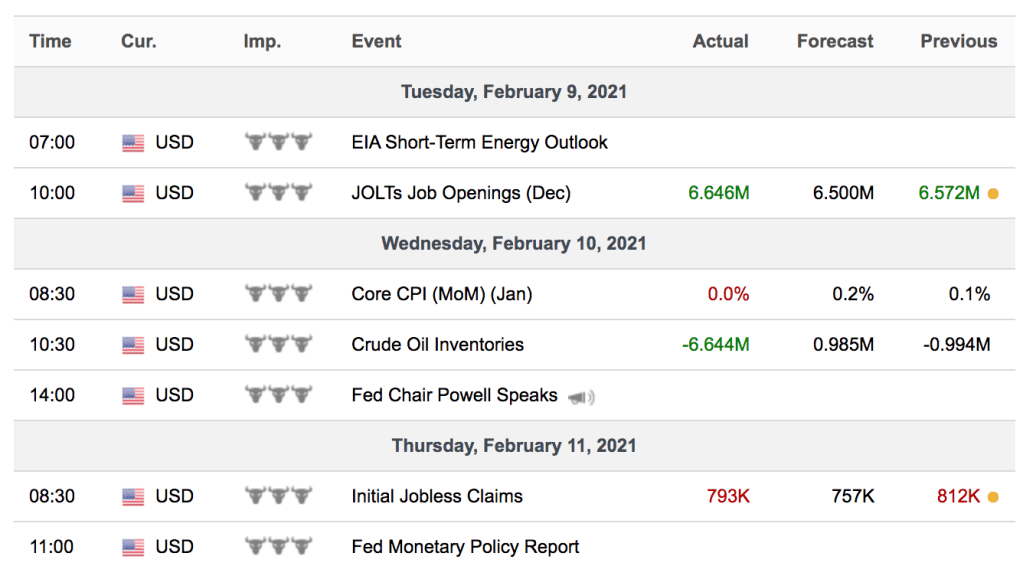
In the week just past, the Treasury market had a few key data points from which to refine forward expectations. The most relevant one on the economic data front was the disappointing core CPI print for the month of January. In January, core consumer prices were effectively flat. In addition, the Treasury market had to contend with the refunding auctions that was $58 billion in threes, which stopped through two tenths of basis point, $41 billion in new tens, which stopped through three tenths of a basis point and $27 billion in thirties, which tailed one basis point.

Post-refunding Treasury yield

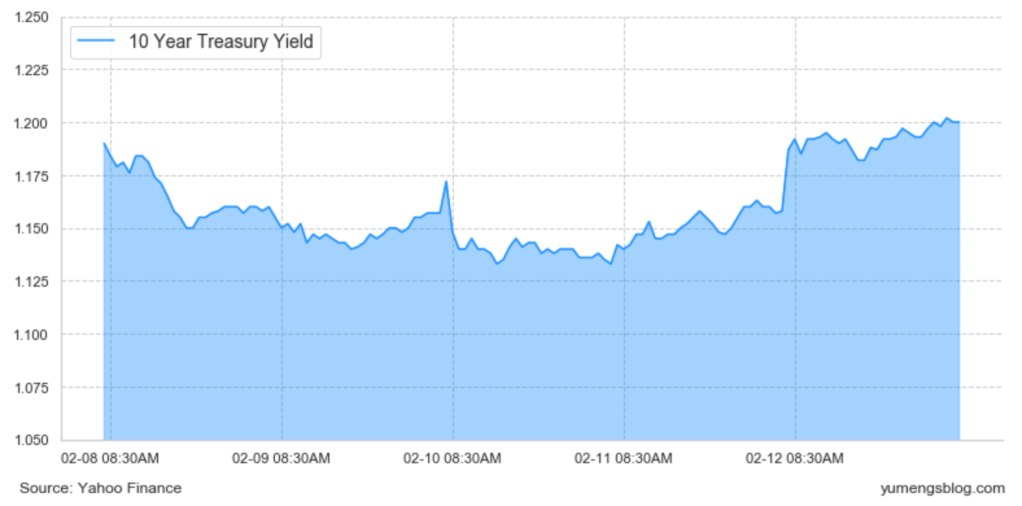
One might be tempted to interpret the results of the long bond auction as a sign of a lack of sponsorship for Treasuries further out the curve. However, refunding 30s, not re-openings have a very strong tendency to tail, having done so now at 9 of the last 11 refunding auctions. This leaves us reluctant to interpret those results as anything more than strong, ongoing sponsorship for duration in the Treasury market. If nothing else, we learn that there’s a potential for reasonable domestic sponsorship for 10-year yields above 1.15. Now whether or not that translates through to the establishment of a new upper bound for 10-year rates at 1.20 remains to be seen. We’ve been focused on what from a technical perspective appears to be a double top. And that’s a double top between 1.19 and 1.20, not textbook, but close enough that it suggests the current period of consolidation might ultimately resolve in lower rates.

Reflation

The Treasury market is trading off of inflation at this point in the cycle than for trading off of the manufacturing sector data, or to a large extent ignoring the employment report. While the distinction between realized inflation and inflation expectations and the divergence that we have seen thus far in 2021 is an important backdrop as we think about the market going forward. We could very easily see the real inflation data continue to struggle as the year plays out, but inflation expectations remain high. It’s also important to keep in mind that headline CPI is heavily weighted toward the energy sector and gasoline prices. And the moves in the energy complex really adds some staying power to this rally we’ve seen in breakevens. Both five and 10-year breakevens are above 220 basis points. And while the underwhelming CPI read should on the margin detract somewhat from those expectations, the fact that we’re seeing such a meaningful pickup in crude and gasoline prices really limits any potential downside should we see a reversal.

Another key distinction is between goods inflation and service inflation. Given that the consumption patterns created during the pandemic have favored goods consumption over service consumption, it makes sense that there was upward pressure on goods prices where flagging service sector inflation became the norm. Fast forward to the second half of 2021, once the economy is reopened and re-engaged in in-person commerce, the baseline assumption for market participants at this point is that we ultimately will see more upward pressure on service sector consumption and inflation to follow.

Fiscal Stimulus

One of the background macro-factors in the market at the moment is the ongoing progress towards stimulus. It’s worth highlighting the results to our pre-NFP survey, which revealed a consensus around market expectations for the ultimate size of the fiscal deal. The most common response was between $1 and $1.25 trillion. But just as interesting, was the fact that no one thought no deal was going to come and no one thought a deal below $500 billion was going to come. For the question how much will the 10-year yield respond to a stimulus deal when it’s finally announced, using that one to $1.25 trillion consensus, anything either materially above or below that will trigger a price response in the Treasury market.

Bulk of Upside in a Classic Supply Accommodation Trade

Review on the past week

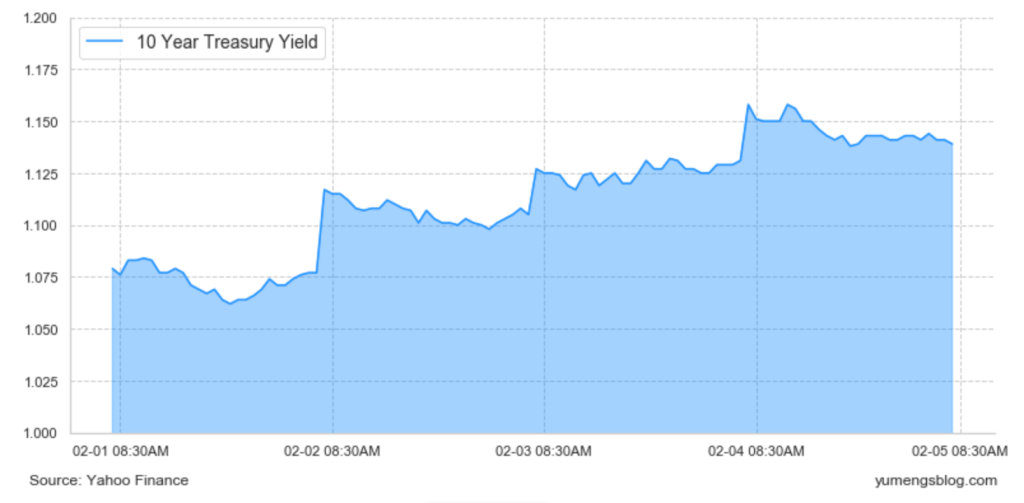
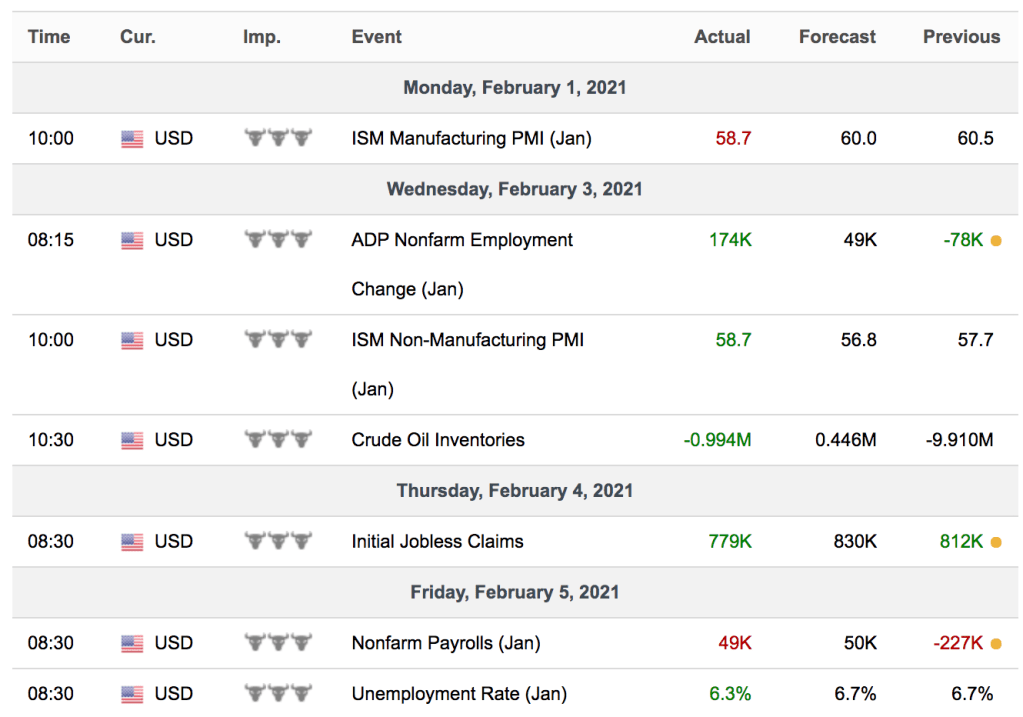
In the week just past the Treasury market had a few key inputs from a fundamental perspective to respond to in terms of pricing. On the jobs front it was a disappointing NFP print particularly within the details where we saw December revised, sharply lower, which if anything marks a relatively low departure point for the beginning of 2021 in terms of jobs growth and more importantly, the idea that the return of lockdowns is in fact having an impact on the frontline service sector and jobs creation. What was notable within the price action was we saw an intuitive bid for Treasuries on the disappointing nonfarm payrolls print, but it wasn’t able to reverse the bulk of the upside that we have seen in rates over the course of the week.

The short-lived bounce could be a reflection of next week’s refunding program with $58 billion threes, $41 billion tens and $27 billion thirties, and the disappointed job print also makes a better case for lawmakers in Washington who are attempting to push through yet another round of fiscal stimulus.

Fiscal Stimulus

This week’s survey was the fact that nobody is expecting either zero deal or a deal below $500 billion. So that does raise the bar for Congress to ultimately deliver and it speaks to this idea that there’s a reasonable amount of fiscal stimulus priced in the market at current levels.

Refunding Auctions

There will be a saturation point for Treasury issuance does remain relevant although there are key offsets that will presumably be put to test over the course of the next several auction cycles. The liquidity provided by the refunding auctions in particular is simply too enticing for big players in the Treasury market to completely ignore, so it’s safe to say that the auction process will be smooth and certainly in a traditional sense.

And on the supply front it’s worth just briefly mentioning the fact that the refunding announcement revealed coupon auction sizes are going to remain unchanged for the next quarter. Now, there was a little bit of a split consensus on whether the Treasury Department would ultimately decide to focus borrowing further out the curve, but for the time being they seemed content with the issuance profile as it is. Eventually the Treasury Department’s longer-term goal is to term debt further out and take advantage of these historically low rates. The art form behind that is to do it in such a way that doesn’t disrupt the market and subsequently lead to higher borrowing rates further out the curve.

EXPECTED V.S. REALIZED INFLATION

We can see sustainably higher inflation expectations as evidenced by breakevens, even if we don’t have that actually translate through to upside risk for inflation in the very near term. If we look at the consensus expectations for Wednesday’s CPI, they’re very much in line with what we tend to see for that series and do not suggest that we’ll be facing a period of upside pressure on consumer prices that the Fed doesn’t want to see.

Another facet that’s worth discussing is before we’re able to really see the true demand-driven type of inflation that the Fed is after, what ultimately will need to happen is upward pressure on wages and upward pressure on real wages that comes along with higher consumer confidence and thus a willingness to spend.

Thoughts on the New Normal

  • Work remotely
  • Move from high-population density areas to the first and second ring suburbs or beyond
  • Drop in labor market participation as at least one parent needs to stay home to fill the gap of childcare that in-person schooling had previously provided

Next to Watch

The two touchstones that matter in that context are record high equity prices and 10-year yields that continue to drift a bit higher. I was encouraged to see the post-NFP bid that brought 10-year rates back to effectively unchanged on the day and cleared the path to trade supply. And that’s what we’re doing right now and that will be the story between 9:00 AM on Friday and Wednesday and Thursday’s refunding auctions for tens and thirties.

Update

Economic Data

Realized yield move

More Fundamentals to Watch for Higher Inflation Expectations

Last week, we did see the realization of the bull flattening that we were anticipating brought 10-year yields from the peak of 119 back to dip below 1%. And then we’ve transitioned to a period of stabilization and consolidation with 10-year yields between 1 and 110. For the next big move, we’re going to need to continue the process of establishing a material volume bulge above 1% before the market is content to take another shot at 125 tens. Whether that actually occurs during the first half of the year is going to be a function of the path of the pandemic, as well as how the economic data unfolds over the course of the next two months.

Reflation

Sympathetic to the underlying reluctance to reprice back to a lower rate plateau, primarily because if we look at the big trade for 2021, and that’s the reflationary trade, what we see is that continues to hold as evidenced by breakevens. We also had a higher than expected core PCE print on Thursday, which reinforced this notion that inflation will slowly start seeping back into the system, putting upward pressure on consumer prices and justifying higher rates further out the curve.

Steepeners

Selloffs are going to be steepeners, rallies are going to be flateners. So yes, we saw a decrease in long end yields below that 1% level in 10-year space, but the retracement has also left the yield curve in a meaningfully steeper territory than we’ve seen for quite some time. This is purely a function of the Fed’s influence on the front end of the curve. Stable front-end rates now are a given.

Possible Range

If we look historically, unless the market is in a moment of massive repricing comparable to what we saw in 2020 or what we saw in 2008/2009, then typically 10-year yields hold a range, on a 52 week look back basis, of somewhere between 75 and 100 basis points. If we apply that paradigm to the current trading environment, that means we could see rates above 125, 135 at some point, as well as a retracement back to that 60 to 75 basis point zone on a meaningful flight-to-quality bid that would most likely be associated with roadblocks on the drive to herd immunity.

Fiscal Stimulus

The $1.9 trillion Biden package initially proposed seemed very unlikely to go through in its current state. Expectations are that that will be scaled back to a number closer to $1.25 trillion, although what is more important is the length of the process to get there. If in fact Congress can cobble together a compromise over the course of the next four to five weeks, that is one and a quarter, that will ultimately have a more significant upside influence on risk assets as well as higher pressure on rates than if a deal ultimately takes three months to come to fruition, even if at the end of the day it’s larger in size.

Expected v.s. Realized Inflation

Currently 10-year breakevens are comfortably above 200 basis points. And as we see the drift above 211, a target of 225 doesn’t seem unreasonable given the Fed shift in its monetary policy framework, combined with all of the fiscal stimulus that’s already come out of Washington, as well as the efforts of accommodation made by the Fed. The bigger concern isn’t whether or not there’s enough fundamental justification for higher inflation expectations, but rather if those inflation expectations can be maintained while the near term realized inflation figures remain in relatively benign territory.

Update

Economic Data

Realized yield move

The Time Has Come, Steepener Thrives

Yes, inflation expectation have been roaring lately marked by the 1oY breakevens touching the amazing 2.0%. Worries over inflation run roughly parallel with concerns that the Fed will tighten policy sooner than expected.

Minutes of the Federal Open Market Committee December 15–16, 2020

The markets were focused on discussion surrounding the Fed’s asset purchase program. Currently, the central bank has been buying at least $120 billion in treasuries and mortgage-backed securities each month. As expectation for higher inflation is in place, markets were looking for signals whether and when the Fed would change in the pace of purchases.

As the December minutes showed,

“Once such progress had been attained, a gradual tapering of purchases could begin and the process thereafter could generally follow a sequence similar to the one implemented during the large-scale purchase program in 2013 and 2014.”

Though the committee voted to keep the current buying pace until it sees “substantial further progress” towards its goals regarding inflation and employment. It’s worth remembering that the last time the Fed cut back on its asset purchases in 2013, it triggered a “taper tantrum” in the market, sending the 10-year yield rising around 140 basis points in the span of four months. There is a good reason that the officials would do what they can to avoid it this time, which I believe is exactly what they are doing now, beginning to lay the groundwork for a taper, managing exceptions.

The treasury markets sure sensed it.

BTW, You know when’s the best time to short Bitcoin? 😉

Update on Jan.12th,

In the week, Fed’s Raphael Bostic said that he would be open to beginning the wind down of purchases as early as the end of 2021, which contributed at least on the margin to 10-year yields run up to that 1.19 level.

But here was also offsetting comments from Vice Chair Clarida, who noted that the size and composition of QE is going to remain stable throughout the year. That corresponded with when rates peaked and a bit of flattening start to re-emerge in the Treasury market.

Note to Self:

Since August, in speaking of real rates, I felt there have been a lot more uncertainties than I could imagine, fiscal stimulus, fed’s policy, presidency election, vaccine development…To be perfect honest, it’s exhausting and I know there is a little piece of me that just wanted to complain and kept questioning whether the decision to trade at high levels and in times of uncertainty was wise. It has been pointed out by a friend who I see as a mentor, that I started with a highly certain trend, captured the opportunity perfectly, true, but in fact the case was rare as well. Now it’s just about time to move on and adapt to the tremendous uncertainties with a more dynamic mindset. Touche. Isn’t the reality always the most complicated? Isn’t the future always full of uncertainties?

2021, a brand new year, maybe a new chapter of my learning journey too?