Thoughts on 2026

Over the past week, the incoming U.S. macro data largely confirmed a continuation of the existing slowdown narrative rather than a meaningful inflection. Backfilled BLS data showed October nonfarm payrolls down 105k, followed by a 64k rebound in November, while the unemployment rate rose to 4.6%, the highest level since 2021. We also saw underperformance in average hourly earnings for the month of November at 0.1%. This brought the year-over-year pace of nominal wage inflation back into the range that defined the pre-pandemic period. In terms of inflation, CPI surprised on the downside in dramatic manner. The year-over-year CPI print came in at just 2.7% and core CPI underperformed expectations at 2.6%. The fact that BLS simply marked some of the changes in OER and the rent components as zero subsequently skewed all of the inflation numbers lower.

Fed policy bias and the outlook for 2026 cuts

Looking ahead to 2026, the Federal Reserve’s policy bias appears increasingly clear: worries on hiring continuing to outweigh inflationary re-acceleration concerns. Employment has become the dominant variable, while inflation as it remains broadly contained, has moved down the list of immediate priorities. Looking forward, the distribution of risks around the jobs market still favor a less restrictive monetary policy stance. And even once Powell’s term is up and we have a new Fed chair, I am expecting that that bias will persist.

At the same time, the Fed prefers owning the front end of the yield curve to the long end of the curve. With government debt levels elevated and refinancing needs rising, maintaining control over short-term rates becomes as much a financial stability consideration as a macro one. Favoring rate cuts or at least resisting premature tightening helps ease debt servicing pressures across the public and private sectors, reinforcing the Fed’s preference for anchoring the front end even if longer-dated yields remain constrained by supply and term-premium dynamics.

equity market considerations for 2026

A more structural challenge sits beneath these near-term policy decisions. Global capital is being aggressively funneled into the AI ecosystem, from semiconductors to data infrastructure. While this investment wave has boosted productivity in select sectors, it has also crowded out employment and consumption growth in more traditional parts of the economy. As capital intensity rises and labor demand softens outside of tech, the Fed is increasingly confronted with data that point to uneven growth—strong at the top, fragile underneath.

This creates a feedback loop that complicates monetary policy. As earnings from major AI companies become macro events that markets trade around, the AI sector has grown too systemically important for policymakers to ignore. In that sense, AI risks becoming “too big to fail” from a market-stability perspective. A dovish fed, intended to support employment broadly, instead channel liquidity disproportionately toward AI and related assets, while offering limited relief to sectors facing structural job losses.

The implication is that, over shorter cycles, monetary policy becomes less effective at addressing real-economy imbalances. Liquidity supports asset prices more readily than it restores employment or consumption in displaced industries. This dynamic raises the risk of further asset-price inflation—even as underlying productivity gains remain uncertain. Heavy capital spending alone does not guarantee a sustained improvement in total factor productivity, and history suggests that such imbalances can eventually surface through higher volatility rather than smooth adjustments.

Against this backdrop, my outlook for 2026 rate cuts is shaped less by traditional inflation metrics and more by labor market fragility and financial stability considerations. The Fed’s easing bias is likely to persist, but its effectiveness may increasingly be expressed through asset prices rather than broad-based economic improvement, setting the stage for a market environment that appears stable on the surface, yet remains vulnerable to sharper dislocations down the road.

Political and fiscal uncertainty as a wildcard

One obvious concern to think about the year ahead is the degree to which the midterm election changes the behavior of the administration. Now we’re going into the midterms assuming that the Democrats take either the House or the Senate and end up with a divided government. This is very consistent with the political wins as well as a typical outcome during the second half of a given president’s presidency. What one would typically think is as a two-term president faces the last two years of his or her presidency with a divided Congress, they would effectively slip into the category of a lame duck or be a placeholder for the next administration. That would typically be characterized by no major initiatives on the legislative front and by a decrease in regulatory changes. Now, that’s a typical environment. Given the current administration’s behavior thus far, it wouldn’t be surprising to see when faced with a divided Congress, the administration tries to further expand the power of the executive branch. Now, whether that translates through to more executive orders and whether or not there’s a concerted effort on the part of the Supreme Court to limit some of the powers of the executive branch all remains to be seen. But, if nothing else, this represents a wild card that could find an expression in the equity market and therefore tighten financial conditions and perhaps more importantly, undermine the wealth effect and thereby cool both inflation and the real economy. According to J. Rangvid, based on current estimates of U.S. household exposure to equities, a 50% drawdown in U.S. equity markets would directly reduce consumer spending by approximately 3.8% and drag GDP growth lower by around 2.6 percentage points. Such a shock would be sufficient to fully offset the historical average growth rate of roughly 2.2%, thereby pushing the economy into a broad-based recession.

Dollar outlook and deficit monetization

Looking into 2026, the U.S. dollar faces growing structural headwinds rather than an obvious bullish catalyst. The Treasury has, for now, helped the Fed navigate a path toward effective deficit monetization, easing funding pressures but reducing the scarcity value of dollars at the margin. This dynamic, combined with a Fed that continues to prioritize labor market risks over inflation concerns, limits the upside for U.S. rates and weakens one of the dollar’s key sources of support.

At the same time, persistent fiscal deficits and heavy Treasury issuance are gradually weighing on sentiment toward dollar assets, even as global alternatives remain imperfect. While the dollar is unlikely to break down sharply given its reserve status, it is also difficult to make a convincing case for sustained strength. The most likely outcome for 2026 is continued range-bound trading with a mild downside bias, driven by easier financial conditions and ongoing deficit financing rather than a dramatic shift in global growth or risk appetite.

Dovish Fed and What’s Going on with Liquidity?

In the week just past, the most relevant macro event came in the form of the FOMC decision to cut policy rates by 25 basis points, widely characterized as a “hawkish cut,” accompanied by an unchanged dot plot implying only one additional cut in 2026. However, the market largely discounted the dots, viewing them as stale given all of the uncertainties surrounding the macro narrative over the course of 2026.

While the initial communication was in keeping with this notion that this week’s cut was something of an insurance measure, what we heard from Powell was taken far more dovishly by the market as the chair acknowledged that the persistent inflation risks resulting from tariffs have not been as severe as initially feared, and there is still plenty of concern around the state of the labor market, which means that the Fed is going to need to continue normalizing rates. Afterall Powell is still in easing mode.

In the meantime, the Fed surprised the market with an earlier-than-expected activation of its Reserve Management Purchase (RMP) program, effectively hedging liquidity risks that showed up as year-end funding pressures emerged. While expectations around the pace and scope of rate cuts in 2026 have cooled, the Fed delivered a more dovish liquidity package than anticipated by announcing the start of RMPs sooner and at a larger scale. In the first month alone, the Fed committed to buying around $40 billion of short-dated Treasuries under three years and signaled that elevated purchasing levels would persist in the months ahead.

This decision came against a backdrop of volatile Treasury General Account (TGA) balances as the government reopened and a sustained decline in reserve balances—recently slipping below 13 % of commercial bank assets. The recent liquidity stress has been pretty visible in risk assets. Bitcoin, often viewed as a liquidity-driven risk barometer, has broken below key technical levels and exhibited heightened volatility.

Part of liquidity tightness can be traced to strategic balance sheet moves by the notably JPMorgan’s withdrawal of roughly $350 billion from its Federal Reserve deposits to buy Treasuries ahead of expected rate cuts. By redeploying these reserves into government debt, JPMorgan materially reduced system-wide reserves, contributing to tighter money market conditions and higher repo rates before the Fed’s liquidity interventions.

The reserve management purchases at $40 billion a month began on the 12th of December is a clear effort on the part of the Fed to support the bill market. I have to mention, using the Fed’s balance sheet to effectively monetize the deficit has long been a risk. And now that it has come to fruition, the takeaway is it’s not a significant market event. It will be interesting to see whether or not the Fed ultimately needs to increase the size of these purchases, but for the time being, $40 billion did air on the higher side of many estimates. The reserve management purchases also came earlier than the market had anticipated, although it does follow intuitively that the Fed would want to get ahead of any potential year-end funding strains.

In fact, a bigger surprise was the language contained in the implementation note, which included the potential for the Fed to buy securities with maturities up to three years. Now, we did see the upcoming month’s purchase schedule released, and it didn’t include anything other than bills, but in interpreting the steepening of the curve, the fact that two and three year notes may potentially be eligible to be purchased, with obviously an emphasis on flexibility from the Fed’s perspective, certainly contributed to the front-ends out performance in the aftermath of the FOMC. And we’ve already had enough conversations about why this is not a QE program, but nonetheless, the slightly longer maturity profile of what might be purchased in the RMPs represented new information that was not the consensus around what the program would look like going into the Fed.

Taking a step back, and I think it’s important to put the Fed’s decision in the context of what the Treasury Department has been messaging in terms of its issuance intentions. It is notable that one of the market’s biggest concerns from a bond bearish perspective over the course of the summer had been the growing deficit and the forward implications for Treasury issuance. When coupled with the fact that Bessent has clearly communicated the Treasury Department will be primarily utilizing the bill market to fund the deficit, this brings us back to one of our key observations about the interplay between the Treasury Department and the Federal Reserve at the moment. And that is that Bessent has effectively forced the Fed into monetizing the deficit. Now with reserve management purchases, the new norm, it’s not QE, but it is expanding the Fed’s balance sheet, we suspect that it will be difficult for the Fed to back away from those programs for the foreseeable future. And looping this back to the concern that these purchases going potentially all the way out to the three-year sector, as the November refunding statement outlined, while the Treasury Department will be focused on bill issuance over the next fiscal year, come fiscal year 2027, which is November 2026, front-end coupon auction sizes are likely to increase, while 10s, 20s and 30s are more likely to be stable. So in the vein of the Fed monetizing the deficit, policy makers have left open the window to extend that all the way out to the two or three-year sector.

Well, after we spent a lot of time discussing who might it be that would serve as the incremental buyer of treasuries, turns out his name is Kevin Hassett.

And he’ll take two.

What Could Push 10-Year Yields Higher from Here

Employment is back in the driver’s seat—and inflation has been politely asked to move to the back. This week’s market narrative is a familiar one, but with a few important twists: labor data continues to soften just enough to keep the Fed on an easing path, and inflation remains well-behaved enough to stay out of the headlines. But beyond the policy debate, there’s a quieter development worth flagging, the triangular consolidation in 10s. Yields haven’t broken lower, they haven’t broken higher, and yet the range keeps tightening. Whether this is simply a pause, or the market coiling for something more directional—is the question lurking beneath an otherwise calm surface.

Employment in the driver seat

In the week just past, the economic data cemented expectations for another 25 basis point rate cut when the Fed meets on December 10th. Specifically, ADP for the month of November showed a decline of 32,000 jobs. This largely served to reinforce the notion that we’re in a no hire, no fire labor market at the moment. Consistent with this was an unexpected drop in initial jobless claims to 191,000. We also saw the Revelio Labs print at negative 9,000 for the month of November, and that compares with a downwardly revised negative 16,000 in October. Overall, the theme for the employment proxies has been mixed to weaker. As a result, not only has this firmed up expectations for a Fed rate cut, but it also reduces the probability that Powell strikes a particularly hawkish tone at the press conference.

This dim outlook is reinforced by the continued headlines about large-scale layoffs and of course the employment proxies. It’s also worth noting that within the ADP series, we saw all of the job losses coming from smaller businesses. This is very consistent with the fact that smaller businesses are reportedly suffering more from tariffs and the trade war uncertainty. It will be worth following this series to see if, in fact, those job losses spread to medium and large size firms in the near term.

At some point over the last several weeks, there was lots of doubt that the Fed was going to be bringing rates lower. But between some of the rhetoric from the likes of William and Waller, coming into this week, we saw a return of market pricing to nearly 100 percent odds of another 25 basis point cut in December. Now this leaves the question of how Powell is going to characterize next week’s cut. Is it going to be of the insurance variety or is it simply the latest step on the journey closer to neutral? At this stage and looking out into 2026, it’s that dynamic which is occupying the attention.

Well contained inflation

As the jobs data is in the driver seat for the Fed, market has moved past peak reflationary angst that really characterized the summer months in the treasury market. We have now seen that there was some tariff pass-through, but it has been reasonably well-contained. And perhaps more importantly, the core inflation measures haven’t managed to materially accelerate to the point of becoming troubling for the treasury market or monetary policy makers. For evidence, we looked to 10-year breakevens, which are still sub-225 basis points. Now, when we look at this series over a 25-year history, the average is 207 basis points. So we’re still above the long-run average, but nowhere near the 300 basis point peak seen during the pandemic.

As long as tariff pass-through is spread out over a longer period of time, then we won’t see forward inflation expectations reset to a materially higher plateau. In fact, in considering the year ahead, as the realized inflation data comes in, I expect breakevens to drift lower. When looking at the period between 2014 and the end of 2019, what I see is that breakevens averaged 178 basis points. I am using this as a medium-term target for break-evens once the market is convinced that inflation has in fact, not only not reaccelerated because of the trade war, but also continued to moderate as some of the key distortions created by the pandemic have worked their way out of the real economy.

A Triangular Pause in 10s

With the above backdrop, there is still one important caveat when it comes to the treasury market, and that caveat remains the global sovereign debt complex. As we’ve seen across JGBs, EGBs, and gilts, yields have displayed a notable stickiness to the upside. While U.S. Treasuries have partially decoupled in recent weeks, the broader global fixed-income landscape continues to cap the downside in U.S. yields, making it difficult for the 10-year to sustainably trade below the 4% threshold. In other words, this is not an outright bond-bearish environment, but it is one that has constrained the scope for a more meaningful rally.

Technically, this dynamic has manifested itself in the 10-year yield consolidating into a tightening triangular formation, with lower highs pressing down against a firm floor near 4%. Volatility has compressed, signaling that the market is increasingly coiled for a directional move, even if conviction on timing remains limited. Importantly, this consolidation reflects not just uncertainty around Fed policy, but also a balance between domestic disinflationary forces and persistent global term-premium pressures.

While the baseline case still favors range-bound trading, the risk of an upside resolution cannot be ignored. A break higher in yields would likely be driven less by U.S. inflation re-acceleration and more by external or structural forces—including renewed upward pressure from global sovereign markets, the AI capital expenditure, increased Treasury supply absorption challenges, or a resurgence in term premium as liquidity conditions tighten. In that sense, any upside move in yields would look less like a growth scare and more like a plumbing-driven repricing, consistent with a world where global borrowing costs remain structurally higher.

Bad Jobs, Bad Spending, Great Rallies

soft labor data, weak consumption, and subdued inflation

In the week just passed, without question, the most interesting developments and market relevant ones came from the economic data. First, we had the weekly ADP series, which showed the four week moving average at negative 13.5 thousand jobs. That marked the lowest since August. And given that it was for the week ended November 8th, it did provide the market with yet another reason to be concerned about the overall state of the employment market. It dovetailed well with the notion that the Fed will be cutting 25 basis points when it meets again on the 10th of December. Keep in mind that we will see the full November data series from ADP in the week ahead on December 3rd, and that will help level set expectations for the Fed.

We also saw a disappointing retail sales print for the month of September, which was not surprising to me as the two brokers with access to credit card data gave exceptionally low estimates. Here, the control group dropped for the first time since April, printing down 0.1% on a monthly basis. That was versus a 0.3% anticipated increase. Recall that this series is not inflation-adjusted, and as a result, when translating this back into real terms, the implication for real consumption will be even weaker.

PPI, particularly on the core side, came in below expectations as well, printing up just 0.1%. When combined with the CPI data we already have in hand, this gets us to a solid 0.2 for core PCE during the month of September, consistent with further disinflation.

The combination of soft labor data, weak consumption, and subdued inflation has strengthened market pricing for additional easing, driving a bullish Treasury reaction, particularly at the front end, with 2-year yields dipping below 3.50% and 10s gravitating toward 4%.

distributional challenge

If the headwinds for the labor market intensified into the end of the year, that could quite readily get the Fed back into rate cutting mode. There’s also this notion that the wobbles and the equity market have been sufficient to bring financial conditions back on the Fed’s radar and reinforce the idea of an insurance cut.

And it goes beyond simply the intuitive feedback loop between risk asset volatility and financial conditions and instead highlights the broader challenge that the Fed is constantly chasing in terms of needing to set monetary policy for economic participants that are not experiencing risk asset appreciation or the wealth effects influence to the same degree. Lower wage earners that obviously have less exposure to the upside scene in equity markets and are also facing the greatest job uncertainty and the most material impact in terms of household balance sheets from inflation are in a far different place in terms of the ability to consume and ultimately drive growth than a first or second quartile household who has realized impressive real estate appreciation, stock market appreciation, wage growth, and is probably a bit more secure in the employment market. Which of these categories is in the driver’s seat in terms of dictating how the Fed sets monetary policy? On the one hand, reducing restriction to acknowledge the challenges faced by lower income households will only then fuel easier financial conditions, higher asset prices, and an exaggeration of the wealth effect and consumption positive influences with what that means for inflation for upper quartile households. It’s this push and pull that is going to become especially relevant in 2026, given one, the outright level of stocks and two, the potential inflection point that we’ve reached in terms of the trajectory of inflation and the direction of monetary policy.

Actually, one of the reasons that the Fed is so focused on not the overall employment landscape, but specifically the unemployment rate, is that the unemployment rate, which is currently at the highest since October 2021, represents the most acute risk for the bottom quartile, i.e. an acceleration in unemployment that makes it more difficult for the low skilled, low wage earners to remain in the labor market. That would have a direct implication on consumption. However, we’re reminded that the top 10% of consumers account for 50% of consumption in the US., which indirectly begs the question, is the Fed the central bank to the entire economy or the central bank to the stock market? Or the central bank to the primary drivers of demand-side inflation?

A Wider Path to A December Cut

This week, with the futures market was pricing in just a 25% probability of a December rate cut on Wednesday and equity market dropped 4.6% intraday, we finally got some official data release come in to process on the employment side.

Mixed September Job

The form of the September nonfarm payroll payrolls print, which increased 119,000 jobs. This was well above the consensus, which was for 51,000. In addition, the three-month moving average for headline payrolls increased to 62,000 from a downwardly revised 18,000. On its surface, the payrolls report should have been a net negative for the Treasury market. However, on the other hand, what we saw within the details was an unexpected increase in the unemployment rate to 4.4%. On an unrounded basis, it was 4.44%, which effectively means it was close to rounding up to 4.5. Even as it printed, it was the highest unemployment rate since October 2021. Taking some of the edge off of the higher unemployment rate was the fact that the labor force participation rate increased one-tenth to 62.4%. However, at the end of the day, what we saw was 33,000 jobs removed on a net two month revision basis and an unemployment rate that has now reached its highest level since October 2021. But nonetheless, there was enough underlying softness in the September jobs numbers to trigger.

In the wake of the payrolls data, those odds of a December cut had increased to 40%. Now it’s clear that within the employment report, there was something for both the hawks and for the doves, and so I see the release as inconclusive as it relates to December. At the end of the day, I suspect that the path toward a December rate cut in fact got wider, but still largely be a function of the ability of the doves to convince the hawks that another quarter point is warranted before year-end.

Equities as the De Facto Policy Signal

By late November 2025, equity markets had entered a sharp and disorderly sell-off, reversing much of the optimism that had characterized earlier months. What began as a reassessment of stretched valuations quickly evolved into a broader risk-off episode, amplified by thin year-end liquidity and growing uncertainty around the macro and policy outlook.

This has naturally shifted the focus toward the performance of the equity market and an increasingly uncertain outlook for risk assets as we approach year-end. The well-worn narrative around business investment tied to AI, data centers, and marquee technology earnings has done little to arrest the recent drawdown. To be sure, the S&P remains comfortably positive on a year-to-date basis, a level of equity performance that, in isolation, would not typically warrant a monetary policy response. Yet it has been telling that a growing share of discussions has centered less on upside potential and more on valuation risk.

Over these past few weeks, it is increasingly centered on stock valuations and just how much downside will be realized if there is a bit of a rationalization of some of the exuberance that’s driven equities to these levels. Extrapolate that backdrop onto an FOMC decision where the Fed may in fact choose to hold rates steady and it’s not difficult to draw the correlation to periods of monetary policy cycles past. We’re heading into the end of the year, there’s risk off impulses that the Fed does not react to, which only then exacerbates the risk off move heading into December 31st, only to have a relatively quick dovish shift, faced early in the new year.

It is, of course, far too early to assert with high conviction that this precise sequence will unfold between now and New Year’s Eve. Still, it is increasingly evident that the U.S. rates market is looking beyond traditional macro releases and taking its cues from equity market dynamics, treating risk-asset performance as an important guide to the Fed’s reaction function in the weeks ahead.

Gold in Uptrends, While Release of Economic Data Creates Buying Opportunity

As central banks race to rescue their economies from complete collapse, trillions of dollars have been pumped into the global economy at the same time. Just like the post-crisis years back in 2009, Inflationary pressures are mounting, which creates a mid-to-long-term bullish outlook for gold.

As for the recent trend, at the June meeting, Fed reiterated its previous guidance that the benchmark interest rate will remain at zero until the U.S. economy is back on track and employment recovers to its previous maximum level. Furthermore, Policy makers were examining yield-curve control strategy (YCC), which central banks in Japan and Australia have deployed to pin down longer-term rates in addition to short-term ones, signaling Fed’s intention to flat the curve and pin it to zero through 2022.

Soon after the Fed meeting, 1-Year Breakeven Inflation Rate edged up to the level above zero, expectations shifted from deflation to inflation. Higher expected inflation combined with a flatter yield curve pinned to zero, led to lower expected real rates. Remember, gold prices are driven by changes in real rates. Supported by the macroeconomic context, the gold rally began.

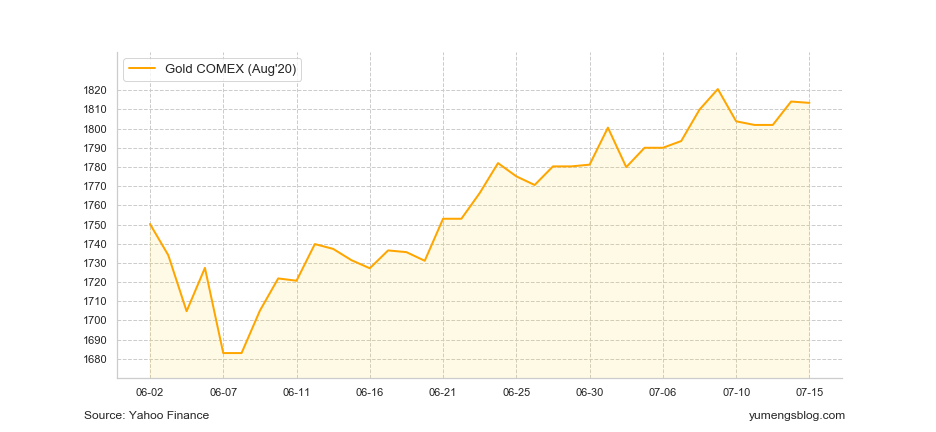
In the last four weeks, gold stormed past $1,800/oz towards its new record high in 8 years,


Certainly, the upward surge has made it more difficult to locate suitable regions for new trades, but looking at shorter-term developments, I have identified some price pullbacks on bearish economic data that proved to be good buying opportunities. In summary, the precious metal fell on short-term optimism, yet quickly rebounded on the long-term worries over inflation and global economy.

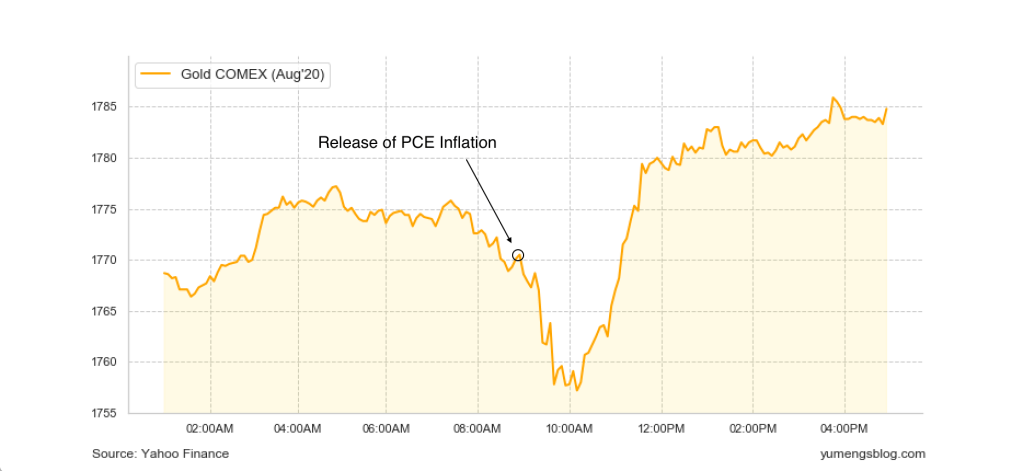
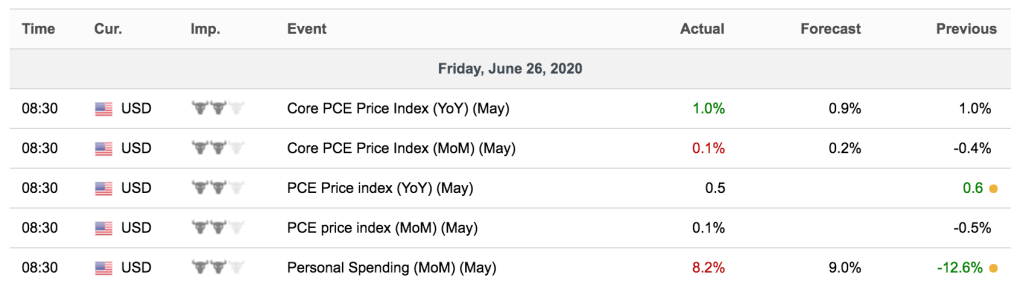
On June.26, gold future (Aug) fell sharply following the release of Core PCE and Personal Spending data for May, trading at around $1755. While from there, the price soon jumped back to $1780, forming a V-shape bounce.


The Personal Spending/Income data showed a monthly increase of 8.2% in consumer spending even as household incomes contracted, which was generally expected as of the huge stimulus package. However, this is likely unsustainable as the access to government stimulus checks will not last forever. Core PCE increased by 1%, it paints a gloomy picture that the US will see a steep drop in consumer spending and inflation remains muted over the summer months. Therefore, gold retreated to the mid-$1700 range.


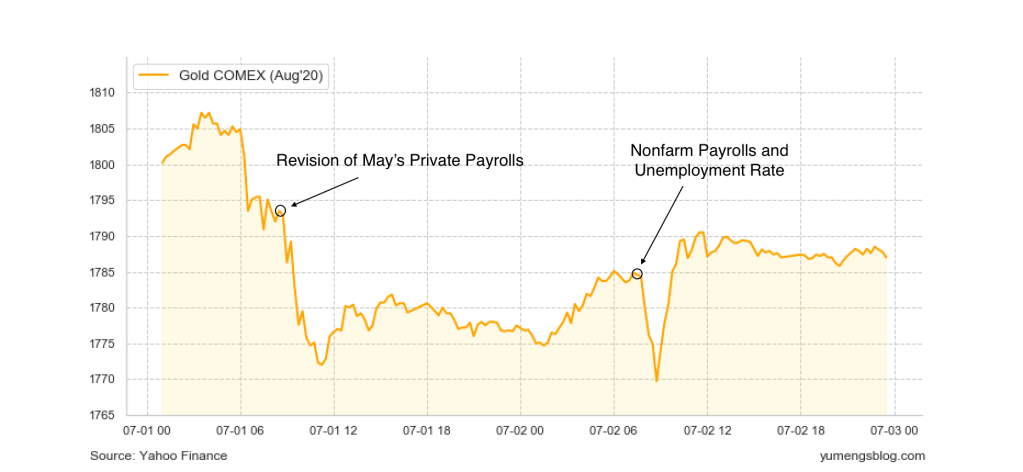
We see the V-shape bounce back again on the first two trading days of July.


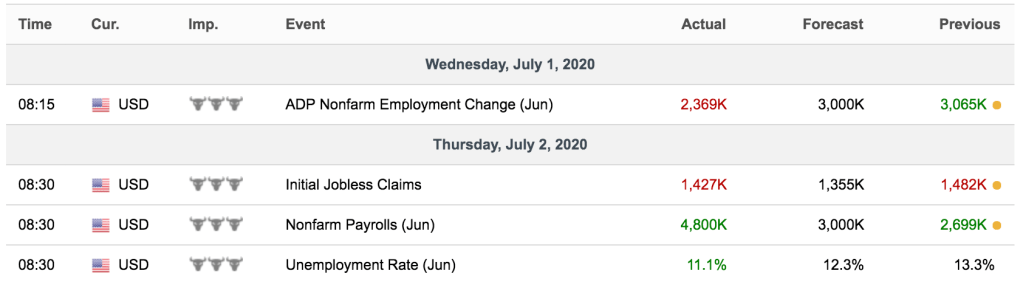
July 1, May’s ADP payroll number was revised sharply higher, going from an initially reported loss of 2.76 million to a gain of 3.065 million, which was one of the largest revisions on record according to APD. Gold prices dropped on the strong revised number, but edged up to $1780 in the afternoon.

The next day, Nonfarm Payrolls rose by 4.8 million, adding a whopping 1.8 million more jobs than expected, and the unemployment rate fell to just over 11%, also beating expectations. Optimism over job growth sent August gold future to its core support at $1770. After that, steady buying soon pushed the price back to $1790.


The movements of gold prices just proved the fact that the broad economy cannot be judged by one data point for one day. People may think the economy is coming back and that the Fed will not have to stimulate as much. While the truth is that the Fed doesn’t have a choice, the world is entering an Era of low growth, high debt, low rates and high inflation. And if you want some hedge against it in the long run, either wait for the next rise, or in the current uptrend, bet on the economic data!