
The market still does not appear to appreciate the severity of a scenario in which conflict in the Middle East meaningfully impairs traffic through the Strait of Hormuz. Current price action remains far too contained relative to the macro significance of that tail risk.
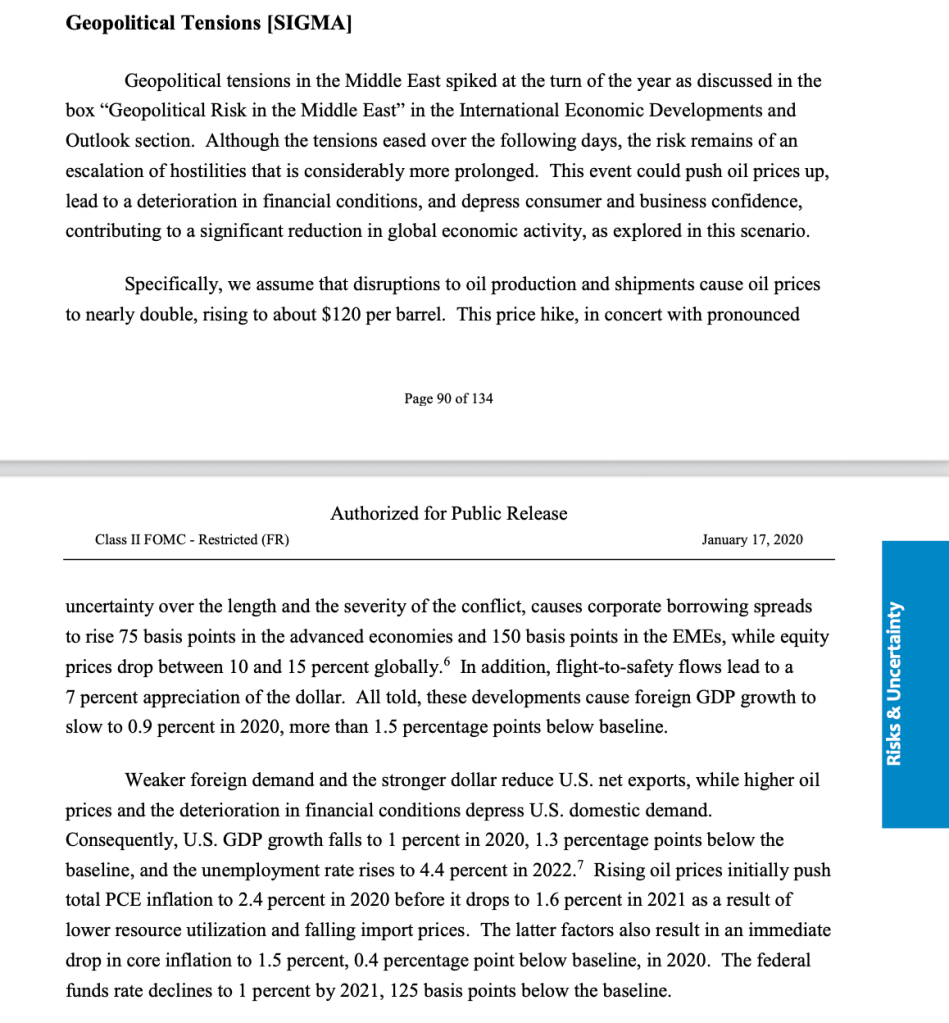
As a matter of fact, Fed effectively modeled this exact type of scenario in its January 2020 Tealbook, where it assumed that disruptions to Middle East oil production and shipments would cause oil prices to nearly double to around $120 per barrel. In the Fed’s own simulation, that shock was accompanied by a 75bp widening in corporate borrowing spreads in advanced economies, 150bp in EM, a 10–15% decline in global equities, and a 7% appreciation in the dollar driven by flight-to-safety flows. The macro spillovers were equally severe: foreign GDP growth slowing to 0.9%, more than 1.5 percentage points below baseline, while U.S. GDP growth falls to 1.0%, 1.3 percentage points below baseline. In the Fed’s framework, this was not a contained commodity move. It was a classic global risk-off tightening event with real consequences for equities, credit, and broader demand. That is exactly why today’s muted price action looks less like resilience and more like underpricing.
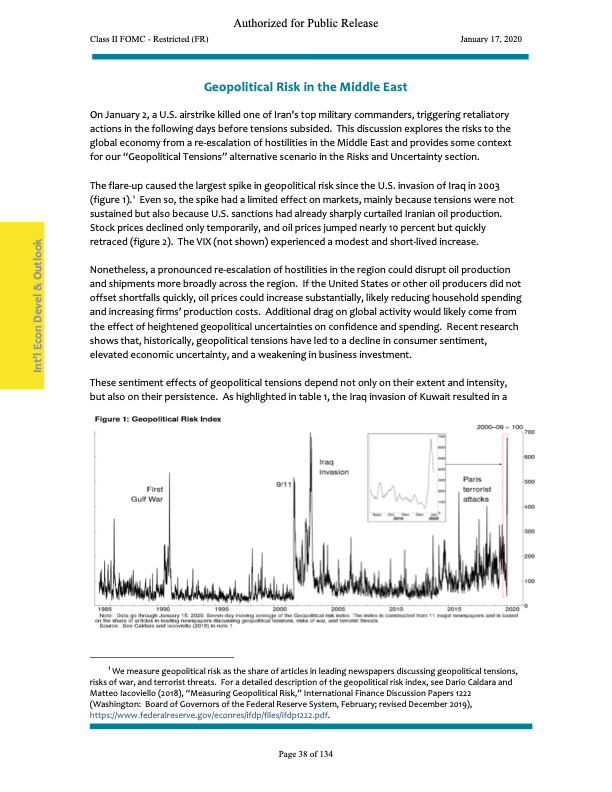
The closest historical analogue remains Iraq’s invasion of Kuwait in August 1990. Iraq invaded Kuwait on August 2, 1990, removing both Iraqi and Kuwaiti exports from the market and, more importantly, forcing investors to confront the possibility that the crisis could escalate into a broader threat to Gulf oil security, including Saudi production and export capacity. The market reaction was immediate and violent. Oil prices rose from roughly $21 per barrel at the end of July to around $28 by August 6, then continued higher to a peak near $40–46 per barrel by mid-October, effectively a near-doubling over the period. Equities moved in the opposite direction. From the date of the invasion to the October oil peak, the S&P 500 fell roughly 17–18%, as the market repriced both the energy shock and the associated tightening in growth and financial conditions. The point is important: the macro shock in 1990 was not driven solely by the arithmetic loss of supply. It was driven by the market’s sudden need to embed a much larger geopolitical and logistical risk premium into the pricing of Gulf oil and, by extension, global risk assets. That remains the right template now. If the market is ever forced to seriously price the possibility that Hormuz transit is no longer secure, the likely move will not be a modest “oil up, equities slightly down” adjustment. History suggests the repricing would be materially larger and much more disorderly.
 All About Macros